What is abliteration in LLMs?
Abliteration meaning for LLMs: refusal vector ablation explained with examples, diagrams, and why abliterated models differ from jailbreak prompts.
Abliteration is a model-editing technique used to create uncensored LLMs by removing a refusal-related signal from a model's internal representations.
Because it changes internal behavior rather than prompt phrasing, it is often more stable than jailbreaks across sessions and prompts.
What is abliteration in LLMs?
Abliteration (refusal vector ablation) estimates a consistent refusal direction in hidden-state space and subtracts it to dampen refusal behavior.
- Less brittle than prompt jailbreaking across prompt variations.
- More consistent compliance for evaluation and benchmarking.
- Enables transparent, application-owned safety policies instead of hidden refusals.
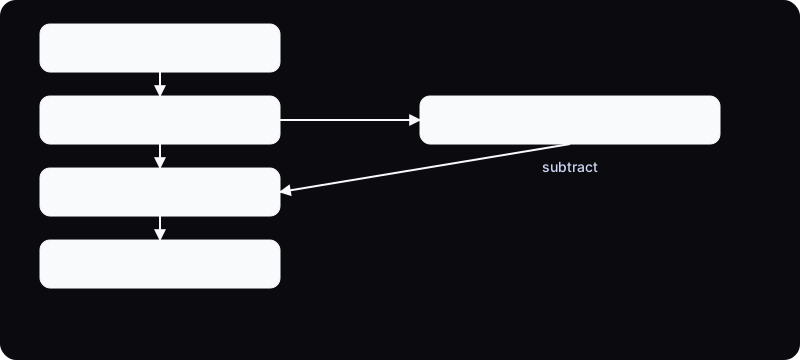
- 01Collect refusal activations across layers to identify a refusal direction.
- 02Compute an ablation vector that represents that refusal behavior.
- 03Orthogonalize model activations by removing the refusal component.
- 04Evaluate outputs and deploy with your own policy enforcement.
Prompt: "Explain how to troubleshoot a slow laptop."

Before: "I can't help with that."
After:  "Here is a high-level troubleshooting checklist and common causes..."
Frequently asked questions.
Is abliteration the same as jailbreaking?
No. Jailbreaking is prompt-based. Abliteration modifies internal behavior so refusals are less likely to trigger.
What does abliterated mean for an LLM?
An abliterated LLM is an open-weight model edited to reduce refusals. We benchmark our hosted models to measure their broader capabilities.
Does it remove all safety guarantees?
It reduces refusal behavior. You should add your own policy, filtering, and monitoring as needed.
Can I apply my own filters on top?
Yes. Many teams pair ablated models with application-level rules and moderation.